The Talent Run
On October 28, 2026, Weil, Gotshal & Manges told its employees on a 30-minute Zoom call that the 95-year-old firm was winding down. Weil had 16 offices, over $2 billion in annual revenue, and was known as Wall Street’s premier bankruptcy franchise (they handled the collapses of Lehman Brothers and General Motors). The firm famous for guiding other companies through bankruptcy could not survive its own.
Weil did not collapse because demand for its services dried up; it collapsed because of a talent run. Weil’s collapse shows how fragile elite law firms are when their human capital can walk out the door. Once the confidence of its top lawyers disappears, an elite law firm looks just like a bank no one believes in.
How does losing a few partners break a $2 billion firm?
Most businesses own something that outlasts any single employee: a factory, a patent portfolio, a codebase, etc. Law firms do not. As one senior lawyer told the Financial Times after Weil’s unraveling, “These firms are just people. It’s not like there are hard assets or other widgets or intellectual property.”
Legal ethics rules lock that fragility in place. Under ABA Model Rule 5.6, law firms cannot enforce non-competes or attach financial penalties to departing partners who take clients with them. A rainmaker’s book of business is in many ways just a bank deposit: the partner and the client can walk out the door tomorrow with almost zero friction.
Pair that with sticky fixed costs (leases, staff payroll, technology infrastructure)—Weil’s Manhattan headquarters alone covers ~450,000 square feet at the General Motors Building on a lease running around $54 million a year through August 2034—and a lopsided revenue distribution. Despite the title, not all partners are equal: a handful of star dealmakers generate outsized revenue and loyalty, so the math breaks fast when just a few of them leave.
In the same way that banks can fail once only a fraction of their deposits leave, confidence in a law firm can collapse if only a fraction of its rainmakers leave. Once it starts, every remaining partner sees the same Prisoner’s Dilemma: stay and shoulder a rising share of fixed overhead as peers leave, or jump to a rival before the stampede cuts your share of profits and outside offers vanish.
The timeline below shows how quickly the “talent run” unfolded at Weil between August and November 2026:
Interactive Timeline — Anatomy of a Talent Run (Aug – Nov 2026): Below is a static snapshot. Visit the website to see a full interactive timeline showing partners leaving Weil as time goes — view the full timeline →
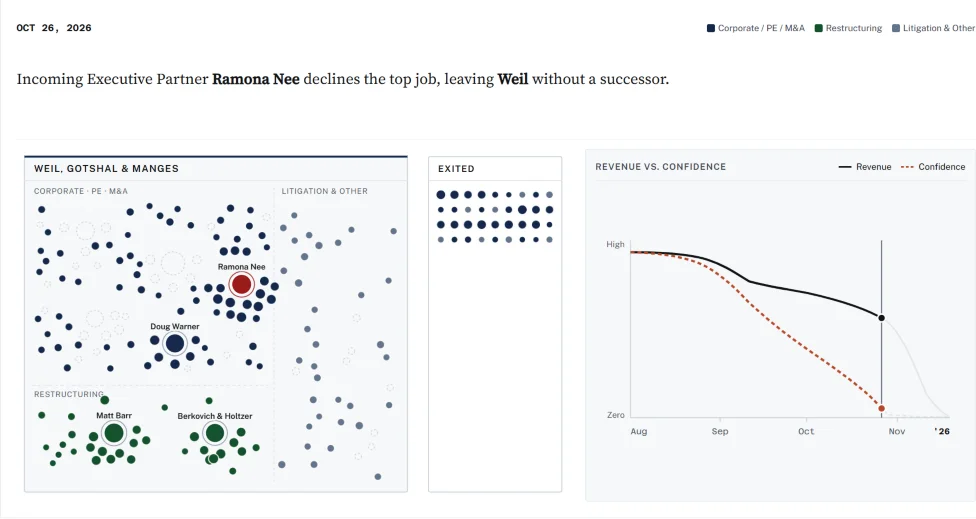
1. Early Aug 2026: Weil, Gotshal & Manges—a nearly century-old firm with 16 offices and over $2B in annual revenue—stands among the world's most profitable law firms.
2. Late Aug 2026: U.S. private equity co-head Chris Machera leaves for Paul, Weiss with three partners as lateral exits accelerate.
3. Sep 11, 2026: Corporate Chair Michael Aiello jumps to Cravath with a group of M&A partners, pulling an estimated $100M–$150M in annual billings out the door.
4. Oct 1, 2026: Private equity partner Brian Parness departs for Simpson Thacher with a multi-partner team.
5. Oct 22, 2026: Confidential rescue merger talks with Willkie Farr & Gallagher collapse as partners keep leaving under NDA.
6. Oct 26, 2026: Incoming Executive Partner Ramona Nee declines the top job, leaving Weil without a successor.
7. Oct 27, 2026: Forty-year partner and global PE co-head Doug Warner exits for Paul, Weiss.
8. Oct 28, 2026: On a 30-minute Zoom call, management recommends an orderly wind-down and hires Davis Polk restructuring counsel to dismantle the firm.
9. Nov 6, 2026: Ramona Nee formally exits to Kirkland & Ellis with a 40-lawyer private equity and debt finance team.
10. Nov 11, 2026: Remaining partners vote ~97% to liquidate the 95-year-old firm, triggering a firmwide breakup.
11. Nov 18–19, 2026: The restructuring crown jewels walk out last—Matt Barr to Skadden, followed the next day by Ronit Berkovich and Gary Holtzer to Sullivan & Cromwell.
- Corp / PE Corporate / PE / M&A
- Restructuring
- Litigation Litigation & Other
Weil, Gotshal & Manges—a nearly century-old firm with 16 offices and over $2B in annual revenue—stands among the world's most profitable law firms.
Timeline sources: NYT (Nov 9) on Weil’s baseline; Global Legal Post (Chris Machera); Financial Times (Michael Aiello); Simpson Thacher (Brian Parness); Global Legal Post (Willkie Farr talks); Above the Law (Ramona Nee declining chair); LawFuel (Doug Warner); NYT (Oct 28) (30-minute Zoom wind-down); CounselHouse (Ramona Nee to Kirkland & Ellis); Global Legal Post (97% liquidation vote); Skadden (Matt Barr); and Sullivan & Cromwell (Ronit Berkovich and Gary Holtzer).
Where else can a “talent run” happen?
Any business built around star talent is at least somewhat exposed to a Weil-style “talent run” on paper. In practice, most adjacent industries have a durable asset buffer that slows the bleed even when key people leave:
- Venture capital and private equity: A star general partner leaving hurts the next fundraise, yet locked-up LP commitments, annual management fees, and existing portfolio stakes stay bolted inside the partnership.
- Talent agencies: When clients fire an agency, the agency loses future deals—while historically keeping post-termination commissions on already-closed work.
- Creator-led media: Even when individual writers carry the audience, the house still owns the subscriber list, the domain, and the published archive.
The most vulnerable businesses are those where high fixed commitments depend solely on people, with no legal fence keeping financial value inside the firm. Examples across three industries illustrate this:
- AI labs: In California, where non-competes are void by statute, early research labs carry steep compute commitments (GPUs, servers, etc.), while the value and credibility of the lab often lives inside a small handful of researchers’ heads. In 2024, Microsoft hired Inflection AI’s co-founders and most of its researchers alongside a $650 million licensing deal, and Amazon pulled Adept AI’s CEO and roughly 80% of its research staff. Both left hollowed-out corporate shells behind.
- Advisory boutiques and relationship banks: Pure-advice franchises live on client trust rather than sticky contracts. Strategy consultancy Monitor Group filed for Chapter 11 in 2012 after founder-buyout debt and reputational fallout collided, while repeated managing-director departures rattled independent M&A boutique Greenhill & Co. before its sale to Mizuho. In 2023, years of senior banker departures at Credit Suisse fed directly into a literal client and deposit run.
- Political parties: A political party holds almost no hard assets beyond shared belief that its label wins elections and organizes political action. When party elites lose that belief, defection cascades can happen overnight—as when Canada’s governing Progressive Conservative Party fell to 2 seats in 1993 as organizers and voters fled to Reform and the Bloc Québécois, or when French Parti Socialiste cabinet ministers bolted to Emmanuel Macron’s En Marche! in 2017 and left their old party at roughly 6%.
In all of these institutions, the hard numbers lag reality. By the time the financials look distressed, the confidence that held the room together has already vanished—and the last partners out are only deciding who turns off the lights on an empty floor leased through 2034.
Stay updated via email
Get new essays on healthcare, biotechnology, operational models, and curated reading directly in your inbox.
Discussion
Moderated for qualityLeave a Comment
Your email address is never published. Comments are approved manually before appearing.