One of the great lessons of the last few years of geopolitics and economics is that it’s not enough to simply have moral/legal authority and money, real power and prosperity requires actual physical inventory and manufacturing capacity.
In a world where Russia is willing to buck sanctions and condemnation to invade a sovereign nation and where trade barriers / epidemics can cut off critical supplies, the ability to produce weapons and medical equipment can be life or death.
It’s no wonder, then, that Taiwan, a mere 100 miles away from a Russian ally/sponsor who denies its independence, has found it wise to start building up its own military production. Learning from Ukraine’s (and now Iran’s) successes with drones against a larger attacker and tapping into growing Western concerns about the China-Russia-Iran axis, they’ve started building drone technology devoid of Chinese parts (“non-red” so to speak), many of which appear to have already been deployed to Ukraine.
In an era where piloted (and eventually autonomous) drone swarms will become a much greater part of warfare, this technological and, just as important, manufacturing capability is vital not only to Taiwan but to the West as it increasingly enters a Cold War with China and its allies.
Before 2025 Taiwan’s defence exports consisted mainly of some old helicopters and small boats donated to African and Latin American countries.
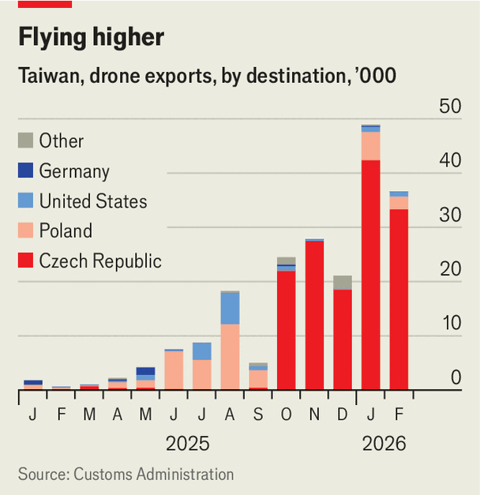
That is changing as Taiwan positions itself as a supplier of “non-red” unmanned aerial vehicles or UAVs—ie, without Chinese parts—to America, its allies and other countries worried about China’s espionage and control over industrial supply chains. Taiwan’s production of UAVs has increased from about 10,000 units in 2024 to more than 12 times that in 2025. Its exports rose more than 35-fold to about 123,000 units last year—almost all its output.
The Czech Republic was its biggest buyer, followed by Poland (see chart). Industry insiders say their purchases mostly went to Ukraine, where many are used on the battlefield, giving valuable feedback on their performance. Another bumper year for exports is expected in 2026, after reaching 85,500 units in the first two months.
Taiwan launched its drone programme after observing Ukraine’s use of the technology. The main aim was to equip Taiwan’s own armed forces, which had just a few hundred drones. China had tens of thousands. Taiwan has since pledged to build an entirely non-red UAV industry by the end of 2026, with annual output of 180,000 units by 2028. Last year it also promised to buy more than 200,000 drones for its own armed forces by 2033.